ARTIST HIGHLIGHT:
JOYCE BARKER SCHWARTZ IN CONVERSATION WITH MADELYN JORDON
Madelyn Jordon Fine Art (MJFA) is pleased to present an exclusive interview with JOYCE BARKER-SCHWARTZ. Madelyn Jordon sat down with Joyce BarkerSchwartz via Zoom to discuss the origins and evolution of her one-of-a-kind woven canvas works. in this conversation, Barker-Schwartz discusses the emergence of her practice from functional, floor-based pieces to expansive wall-mounted compositions. This conversation offers a rare look at her inventive techniques and the thoughtful, process-driven approach that defines her practice.

Joyce Barker Schwartz in her studio. Photograph by Anne Saint Peters
Madelyn Jordon: So Joyce, to start, can you tell me what first drew you to becoming an artist?
"in the beginning"
Joyce Barker-Schwartz: Well, my love of creating started at a very early age. As a child, I always wanted to have a pencil, a brush in my hand, a crayon, whatever it was... It was never about dolls. My younger sister was actually my first model. I made her sit for long periods of time. I wasn’t her favorite person back then, but she was really great. So I knew I wanted to be a creative person. I didn't know what the word artist meant back then when I was little, but I knew I wanted to create and make things.
Madelyn: Can you talk a bit about how your background began to shape your work?
Joyce: My work is really a merger of my fine arts and textile background. I studied both along the way, but I didn’t pursue textiles because I necessarily wanted to work in that field—it was more just an extension of my learning process that led me to what I create now.

Joyce Barker Schwartz : 'Elements' wall hanging 2019. Woven canvas/Acrylic, 102 x 66 in.
Madelyn: That leads me to my next point: how did your process evolve into the woven works you create today? And what first inspired you to begin transforming your paintings through this weaving process?
Joyce: My works have evolved in two stages: Firstly, a number of years back I moved into my current house, and I needed furnishings that functioned at a better than normal level. Looking around, I couldn’t find anything in the marketplace that suited my needs. Having the art background that I do, I thought — well maybe I can make something. So I literally went to my drawing board and figured it out. Then through a very careful multi-step process I was able to develop a way to weave painted canvas into a rug that could be used in high traffic areas. Using this same process, I started make rugs and wall hangings professionally for corporate and residential clients. Today, while I still create functional art for the floor, my main focus is weaving one-of-a-kind wall pieces. So it’s always been about using materials and trying to experiment with them — and how I can take them and reinterpret it. Some of it is functional art, which I love, and some of it is non-functional.

Joyce Barker-Schwartz: Installation picture of 'Retro Stairway'' rug. 8 x 10 ft. Hand painted and woven
Madelyn: I remember your work early on—I absolutely loved your rugs. On that note could you walk me through how they’re made? What kinds of materials do you use?
Joyce: So the base of the rugs are canvas, and then It goes through this multi-step process where It's graphed out, hand painted and hand cut and then it's woven one strip at a time. Then it's sealed with an acrylic finish in order to make it very functional and a backing goes on.
Madelyn: And the wall pieces? Is that a similar process?
Joyce: Well it's a similar process, but I go back to reweave it so it takes on a more three-dimensional aspect. Sometimes the wall pieces involve more work—again, there are layers. I’m building up layers and layers on the surface. Sometimes I break the surface, slitting it and weaving it. Other times I’m coiling, building up on a structure. So it really depends on the work—what I’m doing and what I want to create. When I get to the wall pieces, I can open it up and be more expansive—I can use more materials and build a stronger three-dimensional surface.
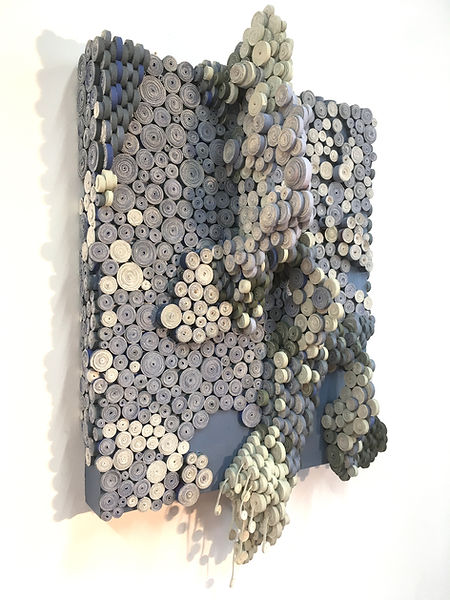
Joyce Barker Schwartz: 'Waterfall Canyon' 2019. Canvas, acrylic, Wood, 28 x 18 x 8 in.
Madelyn: Because your process is so deliberate and multistepped, it really feels inseparable from the final image—would you say the act of making is part of the core of the work for you?
Joyce: If I were to describe my work, I’d say that narrative can be important—but yes, it’s definitely process-driven. Over time, through my creative evolution, I’ve come to think of myself as a mixed media artist, combining fiber techniques with other materials. My primary materials are canvas and paint, and how I use them varies depending on my intent. I tend to work in series, and the direction of each body of work can shift—sometimes it leans more toward narrative, other times It's more about structure or form. I set certain criteria for myself: each piece needs to have movement, energy, strong color saturation, and a lot of texture. If the final work has all of those elements, then I consider it successful.
Madelyn: Tell me, Where do you draw your inspiration from, and how does it influence what you create?
Joyce: My method of work tends to be interpretative. I enjoy observing everything and anything other than what current trends are in the art world, especially artwork that relates to what I am doing in the studio. My approach can rely on context ... I look to nature, architecture, historical references or objects, food, furnishings -- the world is full of inspiration.
Madelyn: Is there a specific moment or experience that you feel has especially informed or inspired your practice?
Joyce: When Covid shut down the world, it became a time of isolation—we were all sheltering in place. My safe haven, mentally and physically, was my studio. Instead of being on the road, I was traveling in my studio. I started a series of painted weavings—images of people and places that stayed in my conscious memory. I spent that time recreating those moments of inspiration. I remember vividly entering a square in Sucre, Bolivia and seeing a family sitting on a bench surrounded by pigeons. I watched them for a while—I was really struck by it. There was no panic, just an acceptance of their surroundings. That body of work was lifeaffirming.

Joyce Barker Schwartz: "Coo Coo Paloma/Sucre" 48 x 60 in. Mixed media, canvas,acrylic paint,woven vinyl strips.
Madelyn: Hearing how personal and intuitive your process is, I’m curious—would you say it’s shaped at all by traditional expectations or the history of weaving?
Joyce: My work evolved for me because of my background— these are the materials I’m familiar with, and I wanted to create something specifically for myself, to see how it would bloom. That’s just how it happened. Of course, the history of textiles is important to me, but this process is really unique to me. It’s a method that I’ve evolved over time and that’s distinct to my practice. It took a long time to get it to where it is today, and a lot of experimenting to develop.
Madelyn: So you came to your weaving process very organically.
Joyce: Yes exactly
Madelyn: Your works feel both intimate and highly constructed. What are you hoping viewers experience when they encounter them up close?
Joyce: Experiencing anything is so subjective. I guess the best way for me to answer that is to think about what draws me to a work of art in the first place. Sometimes it’s the scale, or just whether something feels interesting or provocative enough to pull me in. Like most artists, I like to experience a piece from different perspectives. It might be the imagery, the color, or the design that catches my attention, something that makes me want to move closer and spend more time with it. And then, up close, I start to notice the process, the technique, the texture—those smaller details you only really see when you’re right there with it. If someone can connect with my work on any of those levels, that feels meaningful to me.

Joyce Barker Schwartz : 'Jardin Botanica' 2025. Woven canvas and mixed media, 38 x 60 in.